Rethink the Work
Something Interesting is Happening in Programming
Coding agents have become a serious practical example of AI transforming from simply answering questions to performing useful work . It seems to me this is one of the most innovative, and disruptive events to happen to programmers in the 40+ years I 've been practicing this discipline.
AI coding agents can reason over a user's intent, inspect an environment, gather context, formulate a plan, use tools, observe results, verify their work, recover from problems, and return results back to a human for final judgment.
The interesting thing isn't that generative AI can write code. It's the shape of the work an agent does.
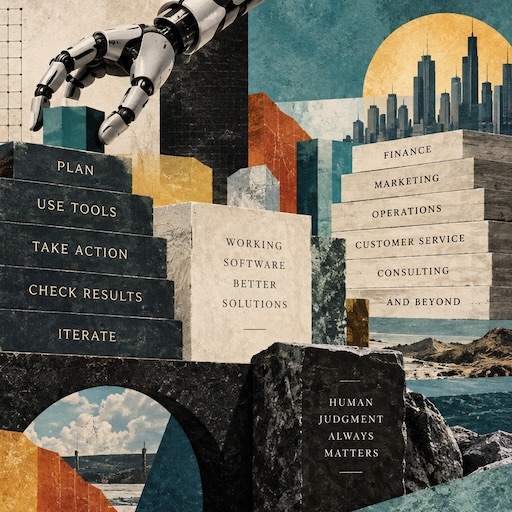
Accelerating computer programming is offering an early look at the fundamental agentic design patterns that will increasingly appear across finance, marketing, operations, customer service, consulting, and other software-driven work.
If you build software for knowledge workers, I think studying how coding agents work is a worthy goal. They're showing us some of the product and engineering patterns we'll spend the next several years applying just about everywhere. Treat this article as a gentle message from the future moment.
This 3-Part Series Will Help You
I've recently developer Rethink the Work as a talk for product-development teams thinking about AI agents, then recorded it as a three Act video series.
Expect to see it offer a practitioner-oriented exploration of what today's AI coding agents can teach us about designing useful business agents.
Product leaders, application architects, software developers, UX designers, QA staff, and technically curious business leaders will come away with something helpful.
Everyone looking at the presentation, and watching the 3-part video series, will gain actionable takeaways around three increasingly import questions:
- What can we learn from working AI agents?
- What conditions makes an agentic system work?
- Where should we apply these patterns in our own domain?
Before we start blasting code, it's worth asking what a successful AI agent looks like, and what today's best example can teach us before we start our own.
Act I: Study What's Working
In the first part of the series, Rethink the Work, Act I: What Coding Agents Teach Us About AI Agents, I take a look at the OpenAI Codex AI assistant from a first-principles perspective. My interest for you isn't that it can write code. It's how agentic applications like these can observe a user's intent, orient itself in a situation, decide what to do, and act on that plan. All the while keeping the human teammate involved.
AI coding agents are my field study, and the related presentation is my guide written to help you map the terrain. Don't copy what coding agents do. Study why the playground of computer programming enables agents to thrive as helpful digital assistants.
Programming offers unusually favorable conditions:
- Accessible Context. The agent can read code, read documentation, review change history, inspect configurations, and peek at system state.
- Executable Actions. It can edit source files, run command-line tools, grep through files, run build scripts, and poke at the environment.
- Tight Feedback. Compilers complain. Linters assert. Unit tests pass or fail. Linkers verify external dependencies. Git history shows changes.
The simple mental model underpinning the entire case study is: See it → Do it → Check it.
Don't copy the AI coding agent's job. Copy the conditions that allow it to work.
Once we recognize the fundamental agentic application design patterns a question forms. What machinery turns a capable model (LLM) into a fully realized system that can repeatedly crank out reliable work?
Act II: Understand the System
In the second part of the series, Rethink the Work, Act II: How to Build Useful, Trustworthy AI Agents we'll take a look at how a capable model (LLM) is only one part of a well-built agent. Useful agentic applications surround the core intelligence with critical components. Components like: context + tools + state + permissions + harness + loop + evaluation + observability + human control.
Recent years of AI development can be described as an expansion of the engineering surface.
- Loop Engineering (iteration)
- Harness Engineering (execution)
- Context Engineering (information)
- Prompt Engineering (instruction)
- ChatGPT (conversation)
Notice that each of these isn't a replacement for the prior one. Your AI engineering surface area kept expanding. An AI agent Harness is a key layer in that stack.
A harness provides reusable machinery that enables a model to pursue work across time.
Applying agentic design patterns will clearly lead you to the requirement for how the AI agent and the human teammate collaborate. Members of the UX and application architecture will need to intentionally build a human-centered control-surface.
Designing the right control surface is crucial. People need to see what their AI agent did, inspect the evidence of its work, understand it boundaries in the system, redirect when necessary, recover if something goes wrong, and approve when outputs are judged successful.
A demo earns attention and a track record earns trust.
Useful autonomy isn't something we simply get out-of-box from a model provider. It's something we mindfully engineer around it. Once we understand the machinery, we're ready for the question that matters to a product team, "Where should really use an AI agent?"
Act III: Apply the Pattern
In the third and final part of the series, Rethink the Work, Act III: How to Find Promising AI Agent Use Cases we identify a practical framework for evaluating work to discover promising agentic problems to solve.
There's a clear antipattern to avoid: Don't begin development with an impressive AI capability and then search for someone to use it. Instead, apply these five questions to help find the right job to build an AI agent to do.
- Is there reoccurring economically valuable work worth improving?
- Can a hypothetical AI agent get enough information to understand the situation?
- Can an agent actually change something rather than merely explaining what a human should do?
- Can a human teammate judge if an agent's work is good?
- Can mistakes be contained, reviewed, and whenever necessary, easily reversed?
Consider these as a way to structure conversations as you and your product team look around the organization to seek out who to help. To get you started, this video has two example agents to run through these five questions. Not to predict what should be done, but to make the framework concrete.
Look for the useful work where context, action, feedback, evaluation, and management boundaries already come together.
A Practical Way to Think About Business AI Agents
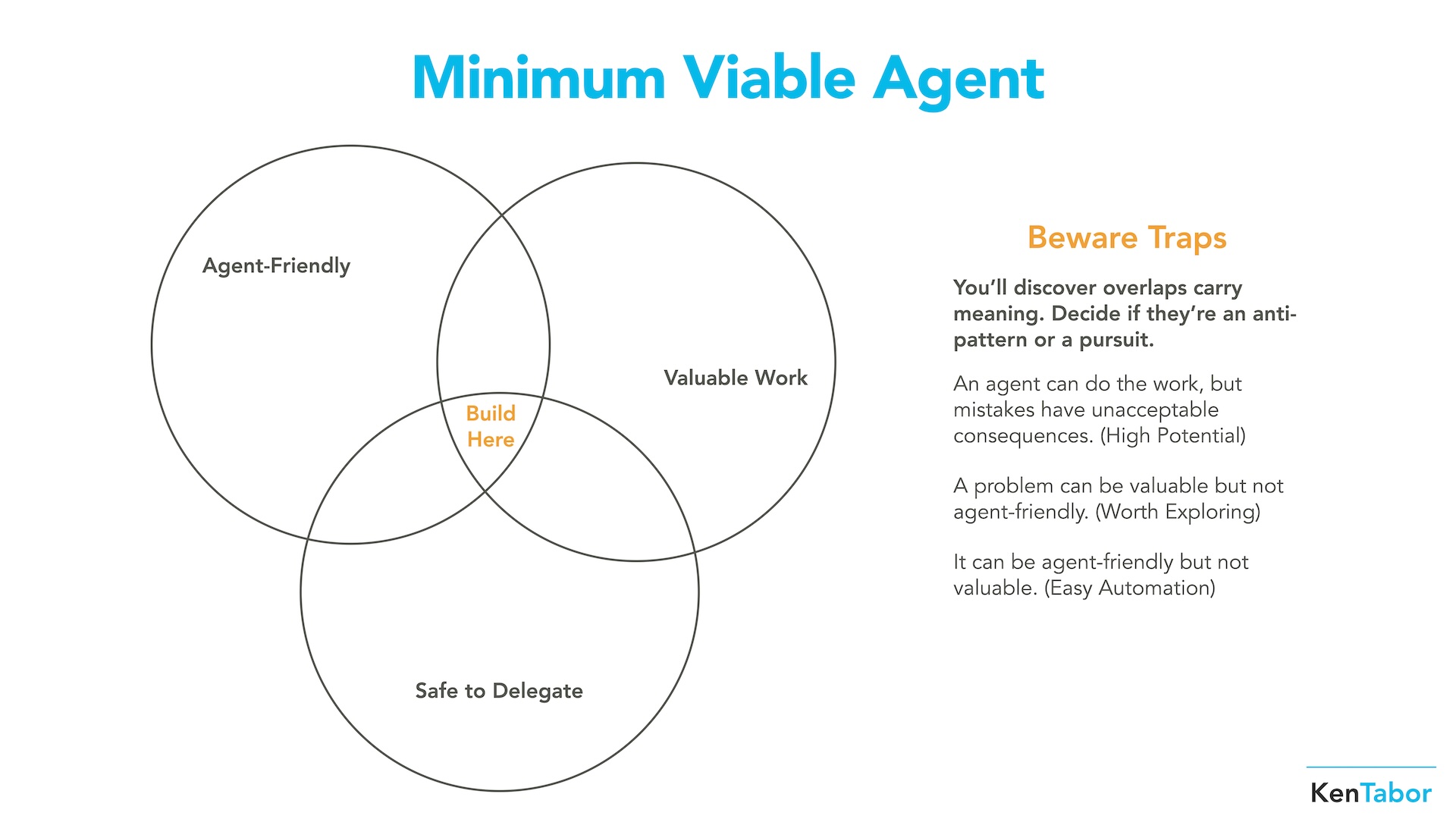
You and your product team should look across your company for jobs that have all the high-value characteristics that make it agent-ready. Ensure it has agent-friendly tools and data, that the job results in recurring valuable work, and has outcomes that are safe to delegate. Imagine it as three large circles.
Dial in and focus up when you discover a problem that sits in the center overlap!
A builder's quick checklist:
- Find recurring friction worth fixing
- Look for accessible context, useful tools, and feedback
- Surround a capable model with state, permissions, evals, and a control surface
- Allow observation and experience justify increasing autonomy
- Preserve human intent, judgment, and accountability
The Larger Opportunity to Rethink the Work
You'll want to build AI agents. This is a good thing because they're the future of software applications. Remember that the goal isn't asking, "How can AI perform today's work faster?" The more important ask is, "If some of the work becomes cheaper, faster, or easier, how should we redesign the work itself.
Maybe software engineers spend less time gathering context and more time exercising engineering judgment.
Maybe marketers spend less time assembling campaign reports and more time understanding customers.
Maybe small-business owners spend less time processing routine inbox requests and more time serving the people who actually need them.
The opportunity isn't increasing productivity. It's leverage. Leverage gives capable people choices about where they spend their scarce and valuable attention.
Resources
Watch the complete series:
Download the associated Rethink the Work slide presentation PDF.
Study, Understand, Apply
We don't exactly know what the next several years of agentic software applications will look like. That's part of what makes this an incredibly interesting time to be a builder.
I'm certain that today's AI coding agents are giving us useful clues. We can study them, extract the design patterns that work, and intentionally apply lessons learned to domains we understand much better than the big AI R&D labs ever will.
Thank you for giving me some of your time and attention. I hope you build something awesome!